
Sleep, REM, and Affective Memory: A Trauma-Informed Guide to Emotional Repair
How REM Sleep Heals the Brain: The Neuroscience of Affective Memory Repair

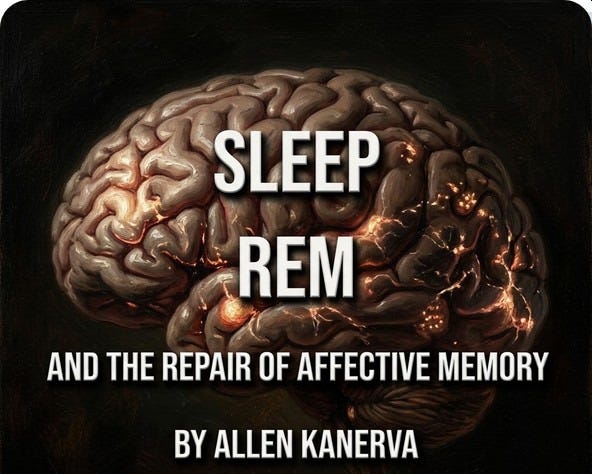
For many survivors of Trauma, the night is not a place of rest, but a landscape of hypervigilance. However, emerging neuroscience reveals that sleep, specifically Rapid Eye Movement (REM) Sleep, is not just a passive state of dreaming. It is an active, biological overnight therapy session designed to process emotional pain.
Understanding the relationship between Sleep, REM, and the repair of Affective Memory is a vital step in moving towards healing that stored trauma.
What is Affective Memory?
Before we can discuss repair, we must define the “emotional engine” of the brain. Affective Memory is the storage of information coupled with its original emotional intensity.
When you experience a neutral event, your brain stores the facts. When you experience trauma, the brain stores the facts plus the high-arousal visceral response (fear, shame, or panic). This is why a specific scent or sound can trigger a full-body reaction years later - the affect (the emotion) is still tightly bound to the memory (the data).
The SFSR Framework: “Sleep to Forget, Sleep to Remember”
The leading scientific model for emotional healing is the SFSR Hypothesis. Developed by neuroscientists like Dr. Matthew Walker and updated with 2026 findings in Physiological Reviews, it suggests that REM sleep performs a dual function:
Sleep to Remember: Strengthening the important facts of what happened so you can learn from them.
Sleep to Forget: Stripping away the emotional blanket from the memory so it no longer hurts to recall.
During REM, this is the only time your brain is completely devoid of noradrenaline (the stress chemical). This creates a safe neurochemical environment where the brain can re-process “hot” memories without the body going into a fight-or-flight response.
The Mechanism of Repair: The Amygdala-Hippocampus Loop
During a healthy REM cycle, two key areas of the brain engage in a “dialogue”:
The Amygdala: The brain’s alarm system that handles emotional salience.
The Hippocampus: The librarian that files memories into long-term storage.
Through Theta oscillations (slow, rhythmic electrical pulses), the brain replays emotional experiences. In this neurochemically calm state, the hippocampus successfully moves the memory into the past tense, while the amygdala dials down its alarm.
In PTSD, this loop is often interrupted. The brain stays in a state of noradrenergic arousal even during sleep, leading to nightmares rather than processing. This is not a personal failure - it is a biological "stalling" of the repair mechanism.
When the System Stalls: The Role of Nightmares
If REM is therapy, why do survivors have nightmares? Recent 2025 research into Systems Consolidation suggests that when a trauma is too large or the nervous system is too dysregulated, the brain cannot achieve the noradrenaline-free state required for repair.
Instead of processing the memory, the brain re-experiences it. This is why Trauma-Informed Sleep hygiene focuses not just on quantity of sleep, but on nervous system regulation before the head hits the pillow.
The Path to Integration
The repair of Sleep & Emotional Memory is a biological imperative. Your brain wants to heal. By understanding the role of REM sleep in trauma recovery, we can stop viewing sleep disturbances as a symptom of being broken and instead see them as a system requesting the safety it needs to complete its work.
FAQ
How does REM Sleep Help Trauma?
REM sleep acts as a neurochemical bath, reducing stress hormones like noradrenaline. This allows the brain to process the emotional charge of a memory, eventually turning a hot traumatic memory into a cool narrative memory.
What is Affective Memory Repair?
It’s the process of decoupling the emotional intensity of a memory from the factual information, allowing the brain to store the event in the past without triggering a present-day stress response.
The goal is not to forget the past, but to reach a place where the past no longer dictates the physical safety of your present.
Allen Kanerva | Founder | Inspyrd Inc
In my previous Trauma-Informed Sleep Article, I discuss: Why Trauma and Sleep Don’t Mix
About the Author
Allen Kanerva is a trauma intervention specialist and the founder of INSPYRD. A former Royal Canadian Air Force tactical helicopter pilot, UN peacekeeping course director, and co-author of Canadian humanitarian security policy work, he developed Affective Memory Resolution (AMR) and Visual-Spatial Tasking (VST), a clinical protocol for nervous-system-level trauma resolution grounded in Hebbian learning and memory reconsolidation research. He trains practitioners internationally in trauma intervention, and mechanism-first change work.
References
Frontiers. (2026). Acoustic stimulation and other emerging approaches to enhance sleep: design notes for the next generation of closed-loop neurostimulation technology. Frontiers in Neuroscience.
Physiological Reviews. (2026). Sleep’s contribution to memory formation. Physiological Reviews, 106(3), 1055-2057. https://doi.org/10.1152/physrev.00054.2024
Frontiers. (2015). The role of REM sleep theta activity in emotional memory. Frontiers in Psychology. https://doi.org/10.3389/fpsyg.2015.01439
Walker, M. P. (2009). The Role of Sleep in Cognition and Emotion. Annals of the New York Academy of Sciences. https://walkerlab.berkeley.edu/reprints/Walker_NYAS_2009.pdf
PDXScholar. (2026). Foundational Knowledge and Other Predictors of Commitment to Trauma-Informed Care. Portland State University. https://pdxscholar.library.pdx.edu/cgi/viewcontent.cgi?article=4642&context=open_access_etds
In this trauma-informed Sleep Article, I explore the neurobiological link between REM Sleep and Affective Memory, explaining how dreaming serves as a critical mechanism for emotional regulation and trauma recovery.
By presenting the latest in REM Sleep Science as well as Neuroscience, I detail how the brain decouples intense emotional charges from past experiences during Rapid Eye Movement cycles to facilitate "Affective Memory Resolution" (AMR).
This targeted breakdown is essential for Mental Health Professionals and individuals seeking to understand why sleep disruption often mirrors nervous system dysregulation, offering a science-backed path toward recalibrating the brain’s stress response and achieving restorative, trauma-informed healing.
Allen Kanerva | Founder | Inspyrd.com