
Stop Asking Why
The most caring question you can ask is the one that quietly keeps people stuck. Here is the mechanism, and the precise replacement.

This article is adapted from the INSPYRD library as part of the Clinical Applications of NLP and Neuroscience series.
The most natural thing to do when someone is in pain is to ask them why.
It is not depth. It is a trap.
Watch a caring person lean in and ask, “Why did you do that?” and watch the other person change: the shoulders up, the eyes flat, a sentence that starts with “because” and turns into a defense.
One word, and a conversation has become a courtroom. This is Episode 28 of the Clinical Applications of NLP and Neuroscience series. In the previous article, I argued that durable change happens at the mechanism, not at the surface. This week the mechanism is language, the most constant input in any room, and the single most overused word in it.
So the clinical question is simple. If “why” is the wrong question, what is it actually doing to the person who has to answer it, and what do we ask instead?
It convenes a court.
It points the blame outward.
It forces a guess about another mind.
It renews the very wound it claims to examine.
If we are going to change a conversation, we have to be precise about what the question is doing.
Why “why” puts people at effect
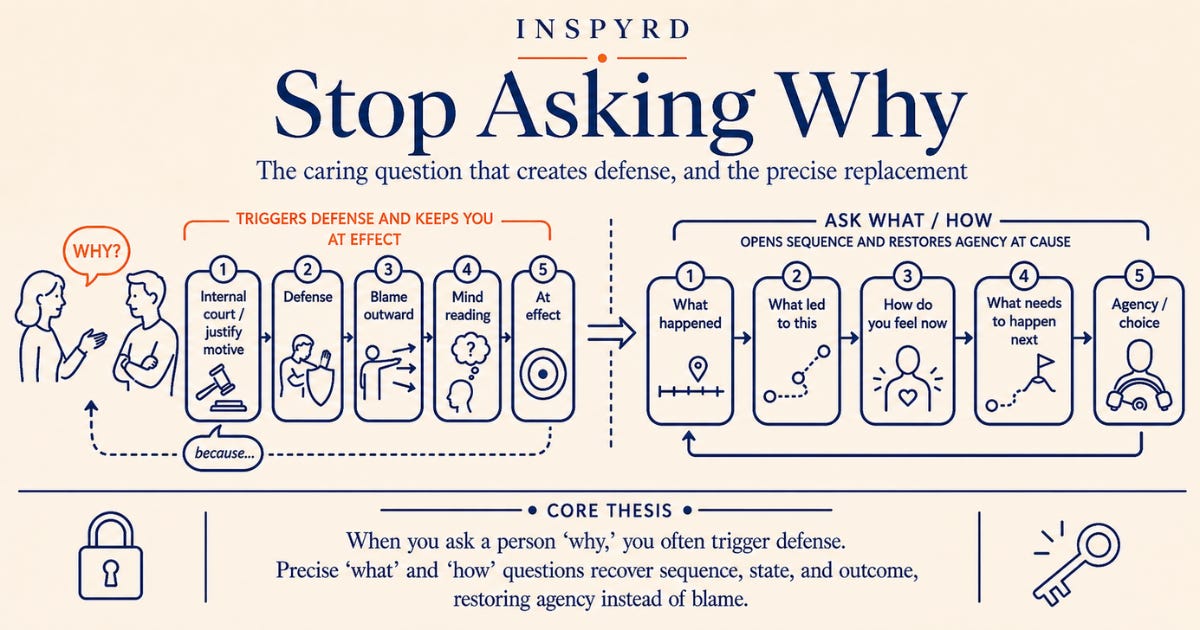
To answer “why did you do it,” a person has to convene an internal court. Locate a motive. Defend a choice. Justify themselves to an examiner. Robert Sapolsky has documented how a perceived social threat narrows cognition toward defense rather than exploration. You asked for insight and you triggered protection.
Then listen to the answer. “I did it because,” and everything after points outward. The traffic. The boss. The childhood. The other person. The sentence locates the cause of the person’s experience outside the person. In my work I call this being at effect, and it is the grammar of victimhood. Julian Rotter and Bernard Weiner named the same split decades ago: external attribution tracks with reduced agency.
The mind-reading trap
The moment a third person enters, “why” becomes impossible. Ask “why did they do that to you,” and the person cannot know. They invent the other’s intentions, then respond to the invention as if it were fact. The NLP Meta Model calls this mind reading. You did not gather intelligence about the world. You helped someone build a sharper story about a mind they will never see.
Words are not labels
Lisa Feldman Barrett’s account of constructed emotion describes a brain that does not passively receive feelings but actively builds them, in part from concepts carried by language. The word is not a label laid over the experience. For a moment, the word is the experience. Ask “why did you fail,” and you do not get a neutral report. You pull the person back into the failure while you are asking. Repeat the question enough and, per Hebb, you wire the reflex in.
Ask what and how
The replacement for “why” is not silence. It is precision. What just happened. What led to this. How are you feeling right now. What would have to happen for this to get better, or to never happen again. Four questions, and not one asks the person to defend a motive or read a mind. They recover the event, the sequence, the present state, and the outcome, which are the only four things anyone can act on.
The full instrument is the NLP Meta Model, built from the work of Virginia Satir. People delete, distort, and generalize as they speak, and the model supplies the exact question that recovers what went missing. “She never listens.” Never? “They rejected me.” How, specifically? You hand the person back the piece they dropped, and they move from at effect to at cause. From the back seat to the wheel.
Where this sits in the series
This is part of the Clinical Applications of NLP and Neuroscience for Healing series, which keeps returning to one idea: change happens at the mechanism, not at the surface. Other entries trace how the nervous system encodes and re-encodes experience. This one moves the lens onto language, where that structure becomes visible and editable in real time.
One question before you go. Of these three, which one do you most want answered:
• Why does asking someone “why” make them defensive?
• What should I ask instead of “why”?
• What is the NLP Meta Model, and how does it actually work?
Comment below. The next article in this series is built on what you tell me. If you work with clients, this is the level we teach inside the INSPYRD certification. If you want a lighter introduction, one-on-one work is available, and you can read more of the framework at blog.inspyrd.com.
FAQ
Why does asking someone “why” make them defensive?
Because “why” asks them to justify a motive, which convenes the self-judging mind and registers as a mild social threat. The body narrows toward defense rather than exploration. Swap “why” for “what happened,” and the threat disappears, because description does not require a defense.
What should I ask instead of “why”?
Ask “what” and “how.” What just happened, what led to this, how are you feeling right now, and what would have to happen for this to improve. Those four recover the event, the sequence, the present state, and the desired outcome, the only four things anyone can act on.
What is the NLP Meta Model, and how does it work?
It is a set of precise questions, formalized by Bandler and Grinder from the work of Virginia Satir, that recover the information people delete, distort, and generalize when they talk. Each limiting pattern has a matched question. “Never” meets “never?” The model restores the missing piece without interpretation, which hands choice back to the person.
Isn’t “why” sometimes the right question?
Yes, in genuine causal or diagnostic inquiry, where you want a mechanism rather than a motive. An engineer asks why a bridge failed. The argument here is narrower: when “why” lands on a person’s choices or on another’s hidden mind, it reliably produces defense, blame, and guessing.
Does this mean I should never let someone explain themselves?
No. It means you replace the question that demands a defense with one that invites a description. People explain themselves far more honestly when they are not on trial.
How is this different from just being a good listener?
Good listening receives what is said. The Meta Model recovers what was left out. It is the difference between hearing “she never listens” and gently returning the word “never” so the person can find the exception they deleted.
Where does this fit in the broader INSPYRD method?
It is the language layer of the same mechanism-first approach that runs through the rest of the work, including Affective Memory Resolution. Change the precise input, and you change the structure the nervous system is running, rather than just the story on the surface.
About the Author
Allen Kanerva is a trauma intervention trainer and the founder of INSPYRD. A former Royal Canadian Air Force tactical helicopter pilot, UN peacekeeping course director, and co-author of Canadian humanitarian security policy work, he developed Affective Memory Resolution (AMR) and Visual-Spatial Tasking (VST), a clinical protocol for nervous-system-level trauma resolution grounded in Hebbian learning and memory reconsolidation research. He trains practitioners internationally in NLP, trauma intervention, and mechanism-first change work.
ORCID iD: 0009-0009-1297-3778
Follow Allen on Substack and LinkedIn.
Read more of the framework at blog.inspyrd.com.
References
Bandler, R., & Grinder, J. (1975). The structure of magic, Vol. I. Science and Behavior Books.
The founding text of the NLP Meta Model, modeled from Virginia Satir and Fritz Perls. It supplies the article’s core claim that limiting language can be met with a precise recovering question.
Korzybski, A. (1933). Science and sanity. Institute of General Semantics.
Source of the map-territory distinction. It grounds the argument that a person responds to an internal map rather than to reality, which is why changing the question changes the experience.
Rotter, J. B. (1966). Generalized expectancies for internal versus external control of reinforcement. Psychological Monographs, 80(1), 1-28.
Defines the locus-of-control construct behind the at-cause versus at-effect distinction, supporting the claim that the external attribution “why” elicits tracks with reduced agency.
Weiner, B. (1985). An attributional theory of achievement motivation and emotion. Psychological Review, 92(4), 548-573.
Shows that the causal attributions a person makes shape the emotion and motivation that follow, substantiating the point that where “why” sends the answer changes the emotional outcome.
Barrett, L. F. (2017). How emotions are made: The secret life of the brain. Houghton Mifflin Harcourt.
The constructed-emotion account in which the brain builds experience using concepts carried by language. It supports the claim that the word is a component of the experience, which is why “why did you fail” re-creates the failure state.
Hebb, D. O. (1949). The organization of behavior. Wiley.
The learning rule behind the claim that a repeated question is a rep that wires a reflex, which is why a helper’s habitual language becomes the client’s inner voice.
and for me it would be...
Why does asking someone “why” make them defensive?
This was excellent AK - I had to read it a few times for my little brain to make sense of it - 🤣 - not the writing or explaining at all - just my lack of intellect 🤣
It’s such athought-provoking and practical piece - around a concept that most people rarely question the use of "why"- and unpack it in a way that’s both accessible and meaningful.
I like how you connected language, neuroscience, and therapeutic practice into a clear framework that can immediately apply.
The progression from explaining the mechanisms behind defensiveness to offering concrete alternatives ("what" and "how") makes it not only insightful but genuinely useful too.
As with your broader series, it reinforces the idea that ever lasting change comes from working with the underlying mechanisms rather than symptoms.
I hope I’ve got most of that down correctly. Either way it was brillint as always.