
The Frustration: Why Knowing Where It Comes From Doesn’t Make It Stop
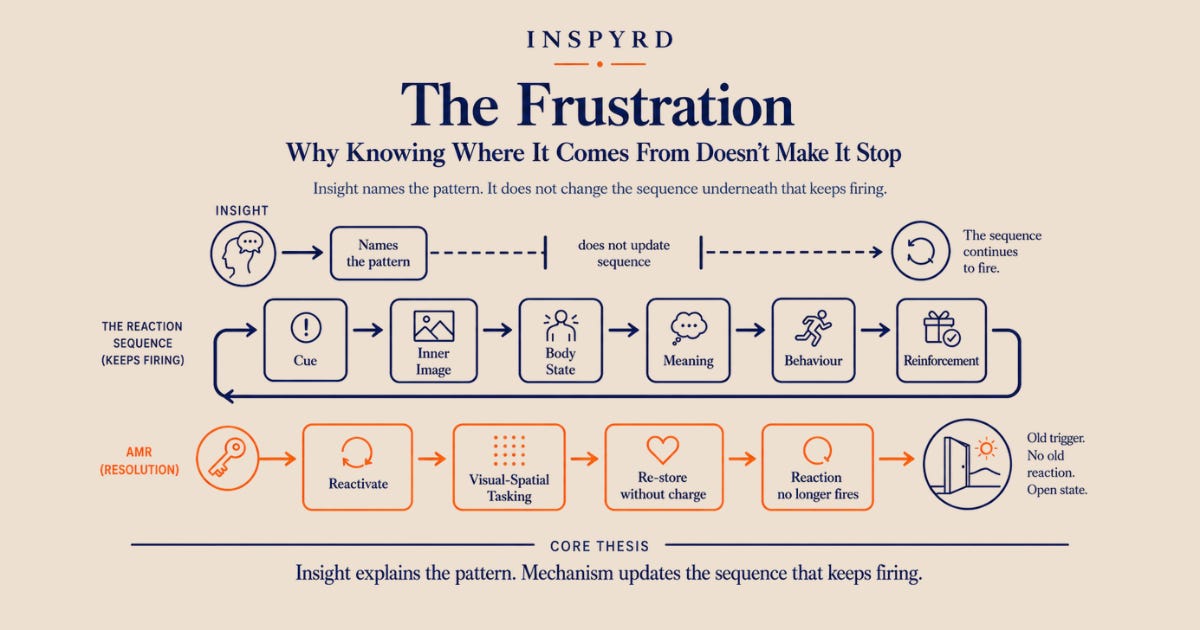
Insight names the pattern. It does not change the sequence underneath that keeps firing.

This article is adapted from the INSPYRD library as part of the Affective Memory Resolution series.
We treat insight as the cure. Understand where a reaction comes from, and it should stop.
It is not.
People finish years of good therapy able to explain their wound in full, and still go cold at the same doorway.
The reaction was encoded as a sequence under threat, and understanding it does not update the encoding. This is the opening piece of the mechanism-first arc. Across the INSPYRD library, I keep returning to one distinction: insight explains the pattern, and mechanism changes it. This piece is about the mechanism.
So here is the question that actually matters. If you can name the origin in full detail and the pattern has not moved, what is the missing ingredient? It is not more explanation.
You understand it.
You can explain it.
You have done the work.
And it still runs.
If we are going to repair an injury, we have to be precise about what got injured.
Insight lives in one place. The reaction lives in another.
The account you can give of your past is one kind of memory. It is conscious, verbal, and available the moment you reach for it. The reaction that fires when a tone changes is not stored there. It runs faster than thought, underneath the level where explanation reaches.
Donald Hebb described the machinery in 1949: repeated firing across the same connection makes that connection stronger, until the path that once needed a reason fires on its own. Insight is a new fact set on top of that path. It does not unbuild the path underneath.
The sequence, not the story
The reaction is not one thing. It is a sequence, and it runs the same order every time: a cue, an inner image, a body state, a meaning, a behaviour, and then the reinforcement as the loop confirms itself. In NLP we call these sequences strategies.
The behaviour you want to stop is the last step. That is why willpower loses. It arrives at the end, long after the body state and the meaning have already fired. You are trying to change the final frame of a film that has already played. The problem is not that you are broken. It is a strategy running perfectly, exactly as it learned to.
You change the sequence, not the story
For most of the last century, an emotional memory was assumed to be permanent once it set. That assumption broke in 2000, when Karim Nader and Joseph LeDoux showed that a reactivated memory returns to a soft, editable state and has to be actively re-stored. Bruce Ecker and colleagues carried the finding into clinical work: the old learning driving a reaction can be reopened and rewritten, not merely counterweighted.
Affective Memory Resolution reopens the encoded sequence. Visual-Spatial Tasking occupies working memory while it is open, so the old charge cannot re-lock in its former shape, and the sequence re-stores without the charge that drove it. This is not calming the reaction down. It is taking away the reason it fires. The body keeps the score is the symptom. The sequence writing the score is what changes.
Regulation helps you survive it. Resolution ends it.
Regulation matters, and no one should give it up. Breathwork and grounding keep you steady while the old sequence is still firing. But regulation manages the last step. You can manage a reaction that should not be firing for years and never once reach what produces it.
Resolution is different. When the sequence updates, there is nothing left to manage at that doorway. The voice still rises sometimes. The body no longer goes cold, because the sequence that produced the cold no longer runs.
Where this sits in the series
This is the doorway into the mechanism-first work. Everything that follows returns to the same distinction from a different lived symptom: why old patterns come back, why regulation is not resolution, why sleep shows whether change is holding. If this piece names your experience, the rest of the series is written for you.
One question before you go. Of these three, which is the one you would type into a search bar tonight:
Why do I still react the same way when I already know where it comes from?
What is the difference between regulating a trauma response and resolving it?
Can you actually change a trauma memory, or only cope with it?
Comment below. The next article in this series is built on what you tell me. If you work with clients, this is the level we teach inside the INSPYRD certification. If you want a lighter introduction, the AMR app walks you through the work experientially, and one-on-one work is available too.
FAQ
Why do I still react the same way when I already know where it comes from?
Because knowing and reacting are handled by different systems. Your insight lives in conscious, verbal memory. The reaction is an encoded sequence stored below it, and understanding the origin does not update that encoding. AMR works at the encoding layer, which is why resolution there stops a reaction that explanation alone never could.
What is the difference between regulating a trauma response and resolving it?
Regulation calms a reaction while it is happening so you can cope with it. Resolution updates the underlying sequence so the reaction no longer fires in the first place. Regulation manages the last step. Resolution changes the sequence itself.
Can you actually change a trauma memory, or only cope with it?
You can change the emotional charge attached to it. Since 2000 the reconsolidation research has shown that a reactivated memory becomes editable before it re-stores. The event is not erased. The sequence that kept firing about it is updated.
Is insight useless, then?
No. Insight is often what makes the work possible, and it can bring real relief. It simply is not the step that stops the reaction. Understanding names the pattern; a different operation updates the sequence that produces it.
Does this mean I have to relive the memory?
No. The memory is reactivated enough to become editable, not re-experienced at full intensity. The point of Visual-Spatial Tasking is to keep the old charge from re-locking while the sequence re-stores, which is close to the opposite of reliving it.
How long does this take?
It varies by person and by pattern, but resolution at the encoding layer tends to be brief compared with years of managing the reaction. The aim is a sequence that no longer fires, not a coping skill you rehearse forever.
What is AMR, in one paragraph?
Affective Memory Resolution is a protocol that reopens the encoded affective sequence driving a reaction and, using Visual-Spatial Tasking to occupy working memory, lets it re-store without its old charge. It works at the encoding layer identified by memory reconsolidation research, which is why it targets the cause of the reaction rather than managing the symptom.
About the Author
Allen Kanerva is a trauma intervention trainer and the founder of INSPYRD. A former Royal Canadian Air Force tactical helicopter pilot, UN peacekeeping course director, and co-author of Canadian humanitarian security policy work, he developed Affective Memory Resolution (AMR) and Visual-Spatial Tasking (VST), a clinical protocol for nervous-system-level trauma resolution grounded in Hebbian learning and memory reconsolidation research. He trains practitioners internationally in NLP, trauma intervention, and mechanism-first change work.
ORCID iD: 0009-0009-1297-3778
Follow Allen on Substack and LinkedIn.
Read more of the framework at blog.inspyrd.com.
References
Hebb, D. O. (1949). The organization of behavior: A neuropsychological theory. Wiley.
The associative-learning principle behind automatic sequences. Grounds the claim that repeated co-firing builds a durable path insight cannot unbuild.
Nader, K., Schafe, G. E., & LeDoux, J. E. (2000). Fear memories require protein synthesis in the amygdala for reconsolidation after retrieval. Nature, 406(6797), 722-726.
The finding that a reactivated memory returns to a labile state and must be re-stored. Supplies the editable window the whole argument rests on.
Schiller, D., Monfils, M. H., Raio, C. M., Johnson, D. C., LeDoux, J. E., & Phelps, E. A. (2010). Preventing the return of fear in humans using reconsolidation update mechanisms. Nature, 463(7277), 49-53.
Extends reconsolidation from animal models to humans, showing a behavioural update during the labile window can block the return of fear. Supports the claim that the mechanism is human and usable.
Ecker, B., Ticic, R., & Hulley, L. (2012). Unlocking the emotional brain: Eliminating symptoms at their roots using memory reconsolidation. Routledge.
Carries reconsolidation into clinical change work. Supports the resolution-versus-regulation distinction and the claim that the sequence can be rewritten, not only managed.
van der Kolk, B. A. (2014). The body keeps the score: Brain, mind, and body in the healing of trauma. Viking.
The reference point this piece credits and moves past. The body carries the imprint; INSPYRD holds that the imprint is a present sequence that can be resolved.
Barrett, L. F. (2017). How emotions are made: The secret life of the brain. Houghton Mifflin Harcourt.
The predictive-brain account: experience is constructed from prior learning. Supports the claim that the body predicts threat from a stored structure, not from the calendar.